HONOR BIO LABS / RESEARCH LIBRARY
How to Evaluate a Research Peptide Supplier
A practical checklist for evaluating research peptide suppliers using documentation, lot traceability, claims, and customer support.
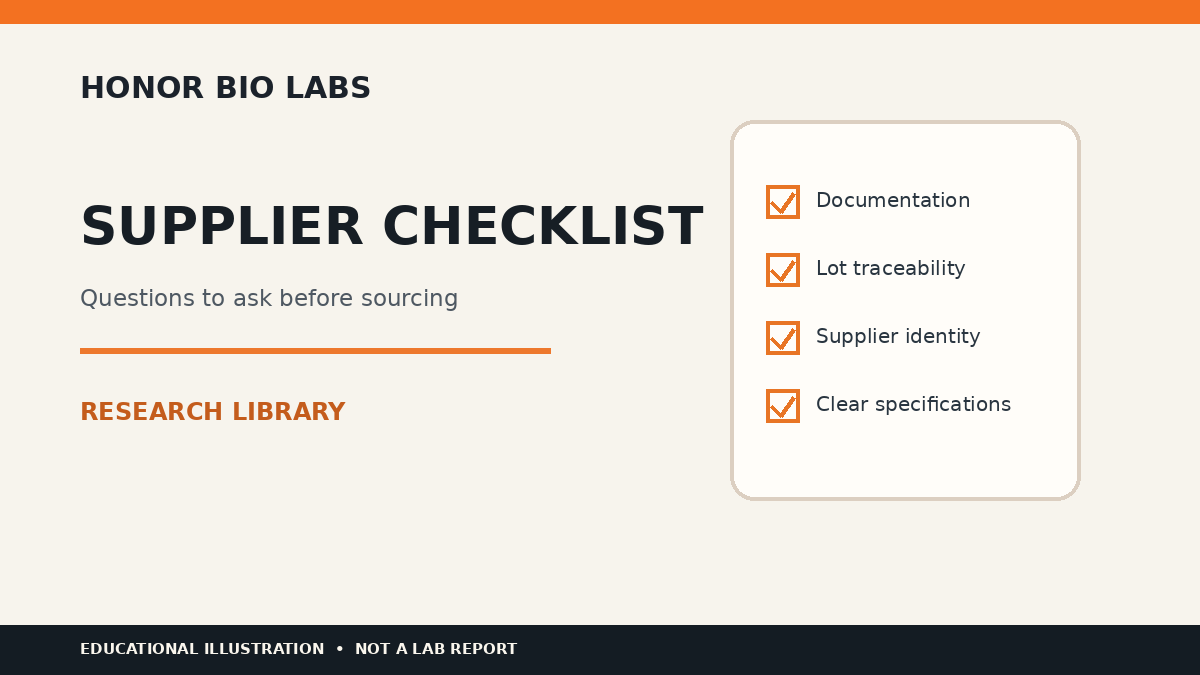
A polished website is not evidence of product quality. When evaluating a research peptide supplier, focus on the information that can actually be checked.
1. Look for lot-specific documentation
A useful analytical report should connect to an identified sample or lot. Ask whether the compound, vial specification, lot identifier, report number, and test date can be matched.
2. Separate identity from purity
Identity and chromatographic purity answer different questions. A responsible supplier should not present one test as proof of every other quality attribute.
3. Read claims literally
Words such as “tested,” “verified,” or “American-made” should have a clear basis. Strong claims deserve equally clear supporting information.
4. Check whether intended use is consistent
Research-use labeling, product descriptions, support, and marketing should tell the same story. Mixed messages create ambiguity about how a material is being represented.
5. Evaluate the support process
A supplier should be able to answer basic questions about SKUs, lots, documentation, shipping, and returns without turning those questions into medical or administration advice.
6. Prefer clarity over hype
Good research supply is mostly about traceability, accurate specifications, and documentation that can be interpreted in context. Those details matter more than exaggerated adjectives.
Honor Bio Labs structures its catalog around those principles. Explore our Quality & Documentation standards or browse the research catalog.
Further reading and documentation
For research-material documentation and sourcing terminology, explore related guidance:
Educational content prepared by the Honor Bio Labs editorial team. Illustrations are explanatory, not certificates of analysis or evidence of test results. For laboratory research use only.
Supplier documentation comparison checklist
Use the same questions for every supplier, including Honor Bio Labs. Record what can be verified independently instead of accepting broad advertising claims.
| Check | What to request | Warning sign |
|---|---|---|
| Lot traceability | A lot identifier on the container that matches the reported sample | A generic COA not associated with the item |
| Identity | A stated analytical method, such as mass spectrometry, and an identified analyte | An unidentified chromatogram offered as identity proof |
| Purity | A method-specific result with clear sample identification | An unsupported purity percentage |
| Independent verification | Laboratory identity and a report that can be authenticated when available | An unverifiable laboratory name or edited report |
| Documentation timing | Clarity on what records are available before ordering | Claims of comprehensive tests without reviewable records |
| Intended use | Consistent research-use labeling and site policies | Human dosing, treatment, or safety claims |
Apply this checklist to us as well. If a report is unavailable for a particular Honor Bio Labs lot, request its status at our contact page rather than assuming that a general testing description covers that lot.
Related research resource
Continue with Why Lot-Specific Documentation Matters for Research Materials for additional guidance on research-material documentation and evaluating evidence.
RESEARCH MATERIALS
Explore the catalog.
Browse research materials with clear vial specifications and lot-specific analytical documentation where available.
Browse Peptides